

Aachen is an odd city in the best possible way. It sits in a corner of Germany so close to Belgium and the Netherlands that locals sometimes cross two borders just to grab groceries. Its thermal springs smell faintly of sulfur, a smell locals call “the Aachen air.” And at its center stands a cathedral that’s been standing for over 1,200 years, outlasting empires, coronations, and countless travel guides. Whether you have one day or three, Aachen rewards people who slow down and look closely.
This is the reason Aachen is on the map. Charlemagne ordered its construction around 796 AD as the centerpiece of his palace complex, and for the next 600 years, German kings traveled here to be crowned.
Thirty-two of them, to be exact. The octagonal Palatine Chapel at its heart is one of the best-preserved Carolingian structures anywhere in Europe, and standing inside it, you get a rare sense of just how deliberately power was made physical in stone and gold.
The Gothic choir added in the 14th century contains Charlemagne’s golden shrine, the Karlsschrein, which still draws pilgrims. Look up at the Byzantine-influenced mosaics; look down at the marble floor. Look everywhere, slowly.
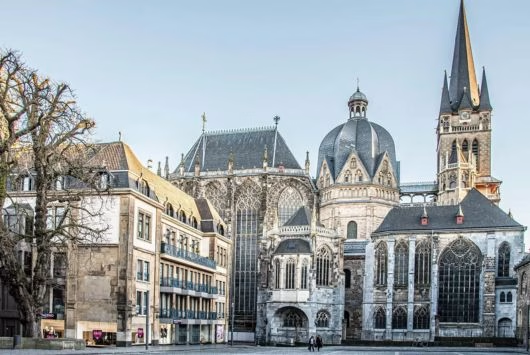
Entry is free. Arrive before 10am on weekdays if you want the nave to yourself. The Cathedral Treasury (Domschatzkammer) charges a small fee but is worth it; some of the oldest liturgical objects in Northern Europe are stored here.
Built in the 14th century directly on the ruins of Charlemagne’s palace, the Town Hall is where the coronation feasts were held after the ceremonies across the square.
The Gothic façade is decorated with 50 statues of German kings; look for Charlemagne himself above the main entrance.
Inside, the Imperial Hall (Kaisersaal) has a painted cycle depicting key moments from his reign, plus replicas of the imperial crown jewels.
The originals are in Vienna, but the scale of the room makes a strong case on its own.
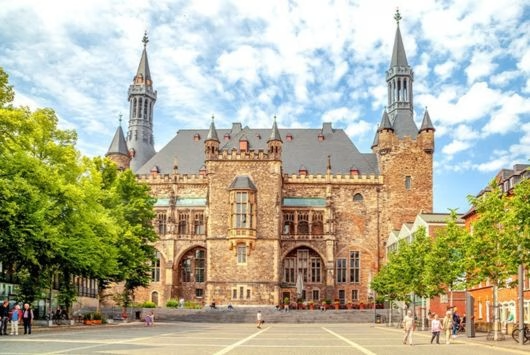
The square between the Cathedral and Town Hall, the Katschhof, is worth lingering in. During the Christmas market, it becomes one of the most atmospheric spots in western Germany.
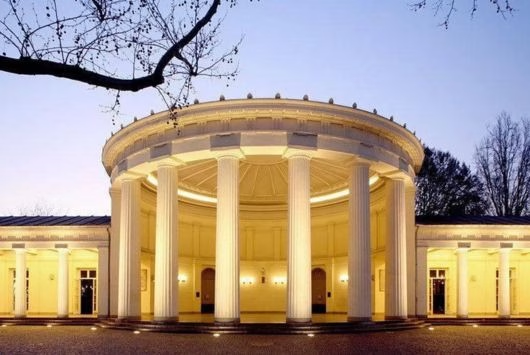
In the 19th century, Aachen was a fashionable spa resort. Monarchs and aristocrats came to “take the waters”, and the Elisenbrunnen, a neoclassical pavilion built in 1827, was where they did it publicly.
Two plaques inside the portico record famous visitors: Dürer, Charlemagne (naturally), and Frederick the Great. The spring water still flows warm and sulfurous from the taps. You can drink it; locals dare tourists to try it.
Behind the pavilion, Elisengarten is a pleasant park that fills up with office workers at lunch. It’s an easy place to slow down for 20 minutes between sights.
Local vibe: In warm months, Elisengarten (right behind Elisenbrunnen) becomes a hangout spot.
Roman soldiers were bathing in Aachen’s thermal waters in the 1st century AD. The tradition never really stopped.
Carolus Thermen is the modern continuation of that history, a full wellness complex with indoor and outdoor thermal pools fed by the same natural springs, plus a multi-zone sauna world with themed rooms.
It’s not cheap, and it’s not a quick stop. Plan at least three hours; most people stay longer.
If you want a slower, more restorative Aachen day, this is the move.
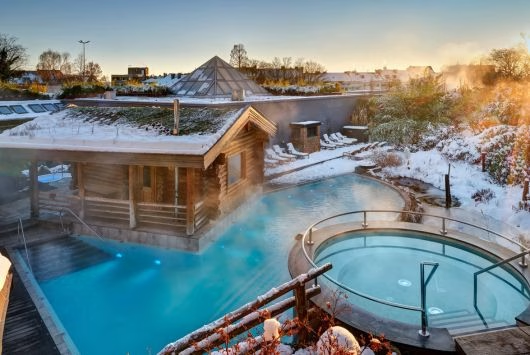
The outdoor pool is open year-round. In winter, sitting in 34°C spring water with cold air on your face is one of the more quietly satisfying things you can do in this part of Germany.
Aachen’s city history museum tells the story of the place from Roman settlement to today, but its real strength is the Carolingian period.
You leave understanding why a small city in western Germany became, for a few decades, the political center of most of Western Europe. The exhibits don’t overload you, the layout is well-paced and the English translations are decent.
This is the right place to come before the Cathedral if you want context, or after if you want to make sense of what you just saw.
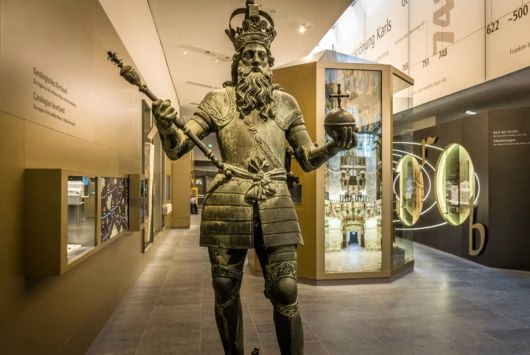
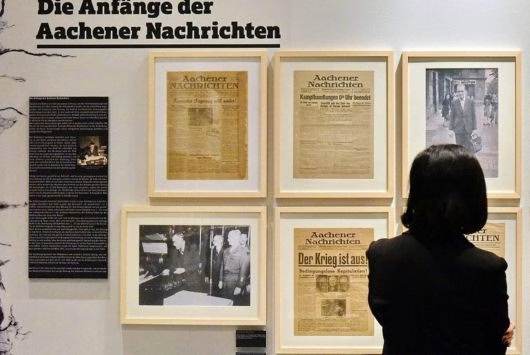
One of the more unexpected institutions in the city center.
The museum documents the history of print journalism across the world: propaganda, wartime press, and the evolution of the front page.
It’s dense but genuinely interesting if you have any curiosity about media history.
Nearby, a plaque marks the spot connected to Paul Julius Reuter, who ran one of the world’s first news wire services and used carrier pigeons between Aachen and Brussels before the telegraph arrived.
It’s the kind of detail that makes a city feel like a real place.
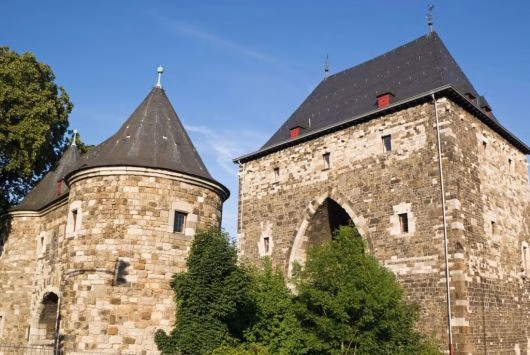
Of the original city wall’s many gates, only two survived the centuries: Ponttor to the north and Marschiertor to the south.
Ponttor is the more dramatic of the two, a 14th-century double-towered gate that still stands to full height.
It’s a ten-minute walk from the Cathedral, and the streets leading to it get quieter and more residential the further you go.
Marschiertor is conveniently placed if you’re arriving from the train station, making it a natural first impression of the old city.
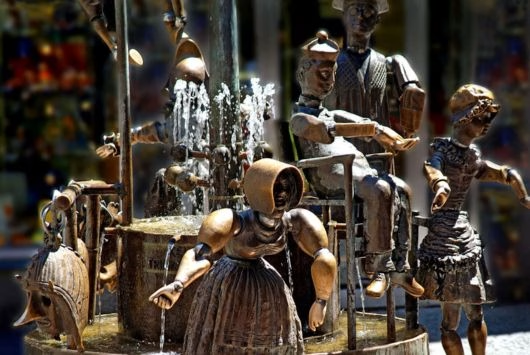
Aachen has an unusual number of fountains, some solemn, some strange.
The Puppenbrunnen on Büchel has bronze figures with moveable parts (tourists habitually rearrange them; locals have strong opinions about this).
The Karlsbrunnen on the Markt shows Charlemagne enthroned, looking mildly displeased.
The Hühnerdieb, a bronze figure of a chicken thief caught mid-escape, is tucked near the Cathedral and easy to miss.
They’re small things, but hunting for them makes a walk through the Altstadt feel more purposeful.
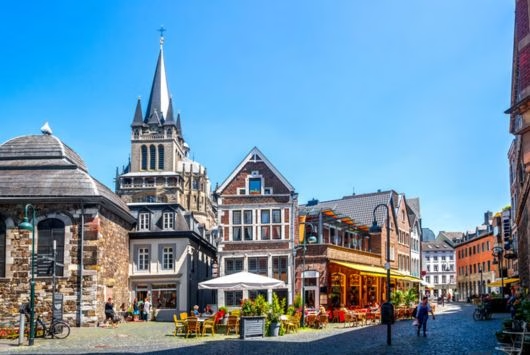
Aachen’s compact center is one of its biggest practical advantages. The Cathedral, Town Hall, Elisenbrunnen, and most of the good cafés are all within a roughly 15-minute walk of each other. The streets between them — Krämerstraße, Pontstraße, the lanes around the Markt — shift character as you go: student bars, independent bakeries, the occasional antique dealer. There’s no wrong way to wander.
A brass-marked walking route connecting the major sites tied to Charlemagne’s legacy, from the Cathedral to the Town Hall to the Centre Charlemagne. It takes around two hours to follow properly, and it gives a useful narrative thread to what might otherwise feel like a collection of unconnected sights.
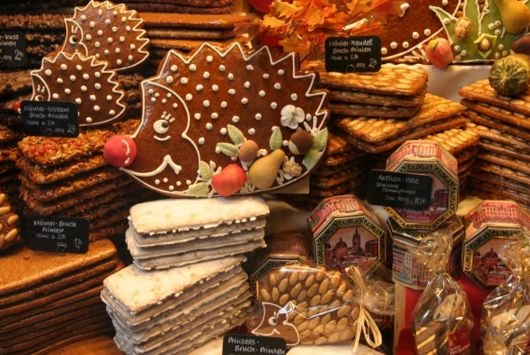
Printen are Aachen’s signature.
They’re baked spiced biscuits, closer to a dense, chewy gingerbread than a crisp cookie, made with a blend of spices that varies by bakery and is, in some cases, genuinely secret.
They’ve been produced here since at least the 15th century, originally sweetened with beet syrup when cane sugar was scarce.
The hard version (Harter Printen) keeps for months. The soft version (Weicher Printen) is better fresh. Both are sold by weight at the central bakeries.
Nobis and Printenbäckerei Klein are the most established names near the Cathedral.
Printen travel well and make a better souvenir than most things sold in tourist shops. Buy them loose by weight rather than pre-packaged for fresher results.
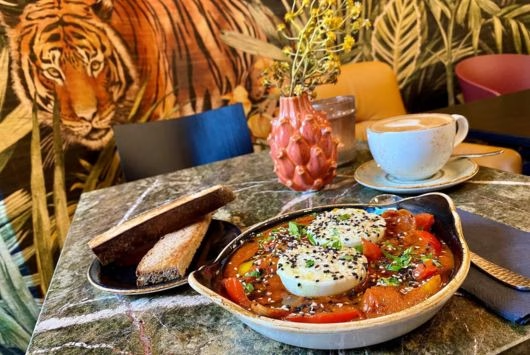
Leni Liebt Café (also written Leni Liebt Kaffee) is the most consistently recommended spot for coffee and brunch in the center; expect good coffee, a relaxed crowd, and weekend queues.
For something closer to the Cathedral, the lanes around the Markt have a handful of reliable options that don’t require any advance planning.
Pontstraße is the main student pub street and more useful for evening drinks than daytime coffee.
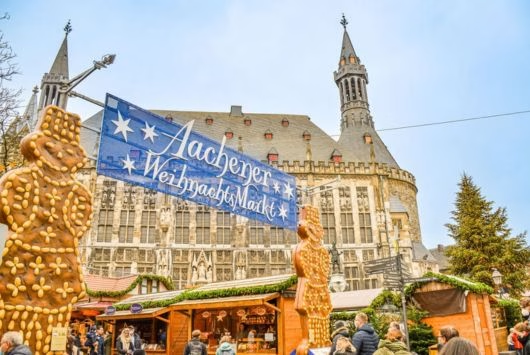
Aachen’s Christmas market is one of the most atmospheric in western Germany, not because it’s the largest, but because of where it sits.
Stalls ring the Cathedral and spill across the Katschhof between the Cathedral and Town Hall, and the combination of Gothic stonework, market lights, and cold air is legitimately impressive.
It runs from late November through Christmas Eve. Come on a weekday evening if you want to move freely; weekends get crowded.
Aachen’s position in the far west of Germany, pressed up against two other countries, makes it an unusually good base for short trips.
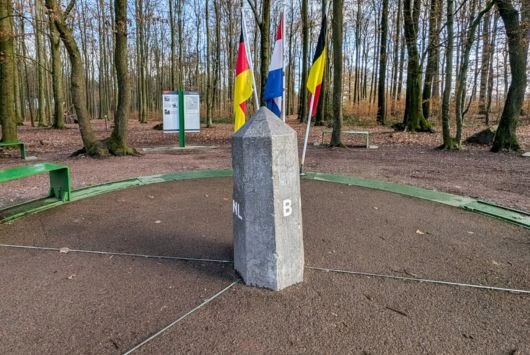
The Three-Country Point (Dreiländereck), where Germany, Belgium, and the Netherlands share a border on a forested hilltop near Vaals, is less than 30 minutes away. There’s a viewing tower, walking trails, and a family-friendly labyrinth on the Dutch side. On clear days the view covers three countries simultaneously, which sounds like a postcard caption but is actually worth the detour.
Liège (Belgium) is 45 minutes by train and has its own cathedral, a famous Sunday market, and significantly better fries. Maastricht
(Netherlands) is similar distance and is one of the more beautiful small cities in Western Europe. Both are doable as long half-days from Aachen.
Yes, particularly if you respond to places with long histories and compact centers. The Cathedral alone is worth the trip for anyone interested in medieval European history. The city around it is pleasant rather than spectacular, but the combination works well for a day trip or a long weekend.
One full day covers the Cathedral, Town Hall, Elisenbrunnen, a walk through the Altstadt, and lunch. Two days lets you add Carolus Thermen, the Centre Charlemagne, the city gates, and a half-day trip to the Three-Country Point without feeling rushed.
Charlemagne, who chose it as the capital of his empire and is buried in the Cathedral. The Cathedral itself, which was the first UNESCO World Heritage Site in Germany. Thermal springs that have been in use for 2,000 years. And Printen.
Cathedral entry, wandering the Altstadt, Elisenbrunnen, Elisengarten, both medieval gates, all the public fountains, and the Route Charlemagne walking trail. The Christmas market is also free to enter. Most of what makes Aachen worth visiting costs nothing.
It’s one of the best cities in Germany for a day trip, precisely because it’s so walkable and the key sights are clustered tightly. It’s well connected by train from Cologne (about an hour), Brussels (under two hours), and Düsseldorf.
Disclaimer:
This page might contain affiliate links. When you click those links and buy something, ABOUT Aachen may earn a small commission. This helps us develop the website and improve our offers.