


Aachen doesn’t ask much of you logistically. The Cathedral, the Town Hall, the thermal spring pavilion, the best bakeries, and most of the city’s museums are all within a roughly 15-minute walk of each other. There’s no subway to figure out, no neighborhoods to shuttle between. You can cover the historic core entirely on foot, at a pace that lets you actually look at things.
What this itinerary tries to do is give that walk some shape; a logical order, a few decisions to make based on what you care about, and enough context that you’re not just ticking boxes. One day is enough to see Aachen properly. Two days let you breathe more.
Start here rather than at the Cathedral. Not because it’s the most important sight, it isn’t, but because it sets the right tone. Elisenbrunnen is a neoclassical pavilion built in 1827 over one of Aachen’s natural thermal springs, and it’s the most immediate reminder that this city has been a destination for a very long time. Two plaques inside the portico list famous visitors across the centuries: Dürer, Charlemagne, and Frederick the Great. The spring water still flows warm from the taps; sulfurous, about 33°C, with a smell that locals have long since stopped noticing. You can drink it. Most visitors try a small sip, make a face, and move on.
Behind the pavilion, Elisengarten is a small park worth pausing in if the morning is clear. In warmer months, it fills up with people on their way to work. It’s a good place to check your map and decide which direction to walk.
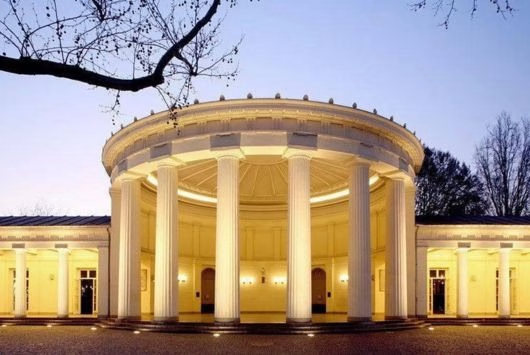
From Elisenbrunnen to the Cathedral is about a five-minute walk through the pedestrian zone.
Entry is free, and the Cathedral rewards time. Not rushed time, slow time. The building has been standing for over 1,200 years, built on Charlemagne’s orders as the centerpiece of his palace complex and later used as the coronation site for 32 German kings.
The octagonal Palatine Chapel at its core is one of the best-preserved Carolingian structures in Europe. The mosaics, the bronze doors, the 12th-century chandelier that Barbarossa donated; none of it photographs well, which is a reason to put the phone down and just look.
The Gothic choir, added in the 14th century, contains Charlemagne’s golden reliquary shrine, the Karlsschrein. It’s still an active place of pilgrimage. If you arrive before 10 am on a weekday, you’ll often have the nave largely to yourself. By midmorning, the tour groups start arriving.
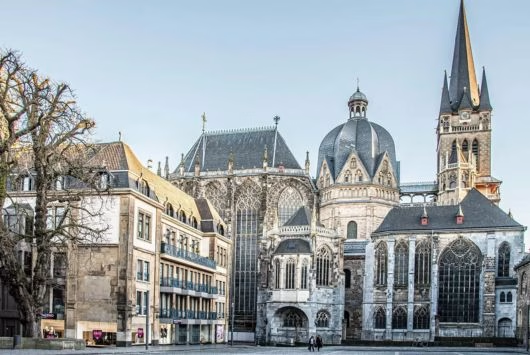
If you want more depth, the Cathedral Treasury (Domschatzkammer) charges a small fee but contains some of the oldest liturgical objects in Northern Europe, including a 10th-century gospel cover and Charlemagne’s hunting horn.
It’s a 20-minute addition that most visitors skip, and shouldn’t.
Cross the Katschhof, the square between the Cathedral and Town Hall, and take a moment to look back. This is one of the better urban views in western Germany: Gothic stonework on one side, a 14th-century civic building on the other, and a square that has been the center of public life in Aachen for centuries.
The Town Hall was built directly on the foundations of Charlemagne’s palace throne room, which is either a coincidence or a very deliberate act of civic continuity, depending on how you read it. The Gothic façade is decorated with 50 statues of German kings and emperors; Charlemagne is above the main entrance, looking appropriately authoritative. Inside, the Imperial Hall (Kaisersaal) has a painted cycle depicting scenes from his reign and replica imperial crown jewels. The originals have been in Vienna since the 15th century, but the scale of the room makes its own argument.
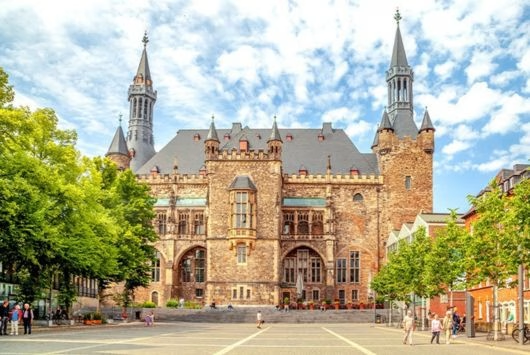
By now, you’ve covered the two non-negotiable sights, and it’s probably late morning.
The streets immediately around the Markt and Cathedral are well stocked with lunch options at every price point.
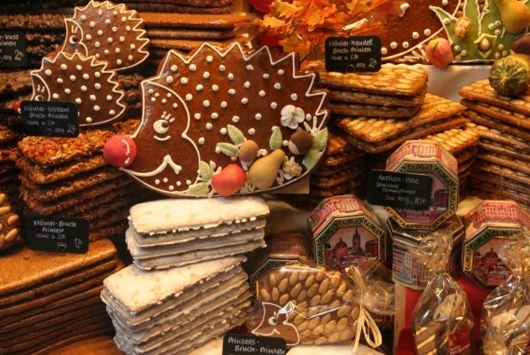
On Printen: Before sitting down for lunch, find a bakery and buy some. Printen are Aachen’s signature spiced biscuits, denser and chewier than typical gingerbread, with a spice blend that varies by bakery and is, in some cases, a closely guarded secret.
They’ve been produced here since at least the 15th century. Nobis and Printenbäckerei Klein are the most established names near the Cathedral, both selling loose by weight. The soft version (Weicher Printen) is better fresh; the hard (Harter Printen) travels well. Buy both.
For lunch: The lanes around Büchel, Krämerstraße, and the Markt have plenty of options. Leni Liebt Kaffee is the most consistently recommended spot for coffee and brunch; relaxed crowd, weekend queues. For a Cathedral view, the Katschhof terraces are the obvious choice on a decent day.
This is where the day splits depending on what you actually want from it. Three realistic options:
If the morning left you wanting more context, the afternoon is the right time for one museum, not two.
Centre Charlemagne is the logical follow-up to the Cathedral and Town Hall: Aachen’s history from Roman settlement to the present, with its strongest material in the Carolingian period. Well-paced, reliable English translations. Allow 60–90 minutes.
Prefer something different? The International Newspaper Museum covers media history, propaganda, and print journalism, and is unexpectedly absorbing. The Suermondt-Ludwig Museum has medieval sculpture and 17th-century Dutch painting. The Couven Museum is the most specific: an intact 18th-century bourgeois interior, worth 45 minutes.
All within walking distance of the Cathedral.
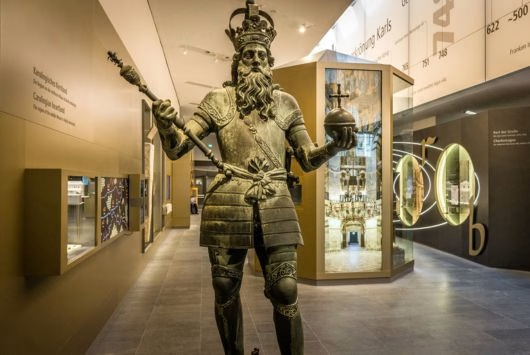
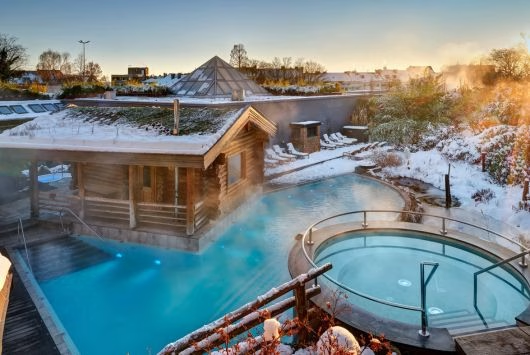
Aachen has been a bathing city since the Romans arrived in the 1st century AD, and Carolus Thermen is the modern continuation of that tradition. The complex has indoor and outdoor thermal pools fed by natural springs (water temperature around 34°C), plus a multi-zone sauna world with themed rooms. It’s not a quick stop; plan at least three hours, and most people stay longer.
The outdoor pool is open year-round. In winter, the combination of warm spring water and cold air is one of the more quietly satisfying experiences available in this city. Bring your own towel or rent one on-site.
This option works best if you started your morning early and are happy to slow down completely for the rest of the day.
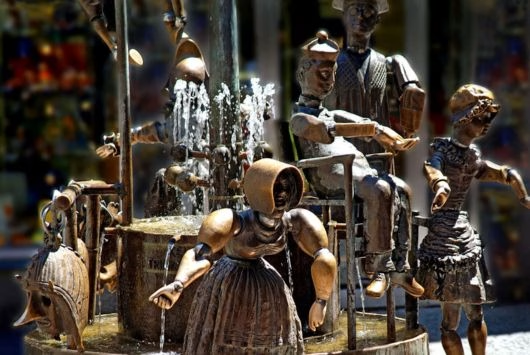
If you’d rather keep moving, the Altstadt rewards aimless walking more than most city centers. A few things to look for:
The Puppenbrunnen on Büchel is a fountain with bronze figures whose arms and props are movable; tourists habitually rearrange them; locals have documented opinions about this. The Hühnerdieb (the chicken thief) is a small bronze figure tucked near the Cathedral, easy to miss if you’re not looking. The Karlsbrunnen on the Markt shows Charlemagne enthroned, looking out over the square he never actually saw.
If you walk north from the Cathedral for about 10 minutes, you’ll reach Ponttor, the more intact of Aachen’s two surviving medieval city gates, a 14th-century double-towered structure that still stands to full height. The streets get quieter as you approach it. Marschiertor to the south is more convenient if you’re heading toward the train station anyway.
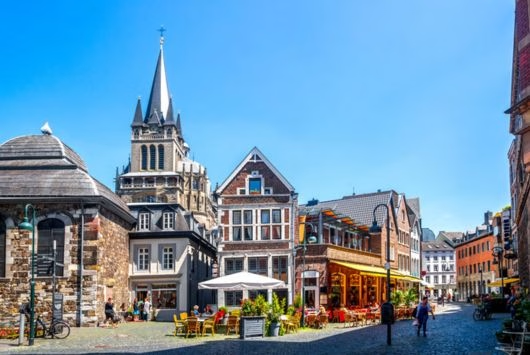
If you’re visiting late November through December, end at the Christmas Market. Stalls ring the Cathedral and spread across the Katschhof, and the combination of Gothic stonework, market lights, and cold air is, there’s no other word for it, genuinely beautiful.
Come after 5 pm when the lights are on. Weekday evenings are less crowded than weekends.
Any other time of year: The Markt in the early evening, with the Cathedral lit and the café terraces still occupied, is a good place to end the day before dinner. Pontstraße is the main student pub street and reliable for drinks.
For dinner, the Old Town has options at every level, from casual Flammkuchen spots to more formal restaurants near the Cathedral.
Aachen is about an hour from Cologne (RE1/RE9), around 45 minutes from Düsseldorf, and just under two hours from Brussels. The train station is a 10-minute walk from the Cathedral, Marschiertor is the first landmark you’ll pass.
The Ludwig Forum for International Art is worth visiting, but sits far enough from the center that it costs you time on a tight itinerary. Save it for a second day.
The Cathedral is at its most atmospheric early on weekday mornings. The Christmas Market runs late November through December 23. Carolus Thermen is open year-round but gets busier on weekends and public holidays.
Disclaimer:
This page might contain affiliate links. When you click those links and buy something, ABOUT Aachen may earn a small commission. This helps us develop the website and improve our offers.